📌 Key Takeaways
- Mental fatigue is a measurable biological state, not just tiredness
- Social media breaks fragment attention rather than restoring it
- A 5-minute game of 2048 provides a genuine cognitive reset
- 2048 engages different brain regions, giving exhausted areas time to recover
- Combining 2048 with the Pomodoro Technique optimises productivity
It's 2:30 PM on a Tuesday. You've been staring at your screen for hours. Your brain feels like it's wrapped in cotton wool. You've read the same sentence five times and still don't know what it says. You're not tired — you're mentally fatigued.
This is the moment when most people reach for social media. They scroll through Twitter, mindlessly watch TikTok videos, or check Instagram for the hundredth time. But here's the problem: social media doesn't reset your focus. It just fractures it further.
There's a better way. A 5-minute game of 2048 can do what social media can't: reset your cognitive state and bring you back to peak productivity. We've experienced this countless times — and so have the millions of people who play our 2048 game at MIA Games. Let me explain the science behind why it works.
🧠 Key Insight: Mental fatigue isn't just about being tired — it's about cognitive depletion. Your brain's executive functions (focus, decision-making, self-control) get exhausted. A strategic break can replenish them.
The Science of Mental Fatigue
Psychologists call it "ego depletion" or "cognitive exhaustion." When you focus intensely on a task for a long period, your brain's executive functions — the ones that handle attention, decision-making, and self-regulation — become depleted.
This isn't a metaphor. It's a measurable biological phenomenon. Your brain uses a significant amount of glucose and oxygen when you're concentrating. After a few hours of intense focus, your prefrontal cortex — the part of the brain responsible for executive function — literally has less energy available.
The result? You lose the ability to concentrate. Your decisions become worse. You're more easily distracted. And you start making mistakes you wouldn't normally make.
Why Social Media Doesn't Help
When you're mentally fatigued, scrolling through social media feels like a break. But it's not. Social media actually increases cognitive load. Each post, each video, each notification requires your brain to process new information, shift attention, and make quick decisions.
Research has shown that even short sessions on social media can increase stress levels and decrease your ability to concentrate afterwards. Instead of resting your brain, you're just changing the type of work it's doing — from difficult work to shallow, fragmented work.
Why 2048 Works
2048 is different. It's a game that requires focused, strategic thinking — but in a way that's fundamentally different from most work tasks. Here's why it works as a cognitive reset:
- It's engaging but not stressful: 2048 is challenging, but it's a puzzle you can solve. There's no external pressure, no deadlines, no judgment.
- It uses a different part of your brain: Work often involves reading, writing, or analytical thinking. 2048 uses spatial reasoning, pattern recognition, and forward planning — different cognitive skills.
- It has a clear goal: Reaching the 2048 tile is a concrete, achievable objective. Completing it gives you a sense of accomplishment.
- It's short: A game takes 5-10 minutes. You can play it, finish it, and return to work without losing too much time.
📊 Why It Works: This lines up with a well-documented concept in cognitive science: alternating between focused, effortful thinking and short, undemanding mental breaks helps your brain consolidate information and return to work with sharper attention. Barbara Oakley, a professor of engineering and author of A Mind for Numbers, calls this the difference between "focused mode" and "diffuse mode" thinking — and it's the same underlying principle behind the popular Pomodoro technique. A short puzzle break like 2048 gives your brain a low-stakes, engaging task that isn't mentally draining the way scrolling social media often is — social feeds are designed to keep pulling your attention rather than let it rest, which is part of why they tend to make breaks feel less restorative even when they take up the same five minutes.
The "Cognitive Reset" Effect
Think of 2048 as a cognitive reset button. When you play the game, you're forcing your brain to shift from its current mode of thinking to a different one. This shift allows the parts of your brain that were overworked to recover.
It's similar to the concept of "diffuse thinking" described by Barbara Oakley in her book A Mind for Numbers. When you step away from a problem and engage in a different activity, your brain continues to work on the problem in the background. That's why you often have insights while showering, walking, or playing a game.
A 5-minute game of 2048 gives your brain time to consolidate what you've learned, reorganise your thoughts, and return to the problem with fresh perspective.
Key Benefits of a 2048 Break
Reduced Stress
Low-stakes gameplay lowers cortisol levels and promotes relaxation.
Cognitive Shift
Engages different brain regions, giving exhausted areas time to recover.
Improved Focus
Returns you to work with renewed attention and concentration.
Fresh Perspective
Allows subconscious problem-solving to continue in the background.
Achievement Boost
Small wins release dopamine, improving mood and motivation.
Time-Efficient
5-10 minutes is all you need for a meaningful cognitive reset.
How to Use 2048 for a Focus Reset
Here's a simple protocol we've developed for using 2048 as a productivity tool:
- Set a timer: Give yourself 5 minutes. No more, no less. This prevents the game from becoming a distraction.
- Play mindfully: Focus on the game. Don't think about work. Don't check your phone. Just play.
- Aim for a goal: Try to reach a specific tile — 128, 256, or 512. Having a goal increases engagement.
- Stop when the timer goes off: Even if you're in the middle of a good game. The break is over. Return to work.
- Reflect: After the game, take 30 seconds to notice how you feel. Are you more focused? More relaxed?
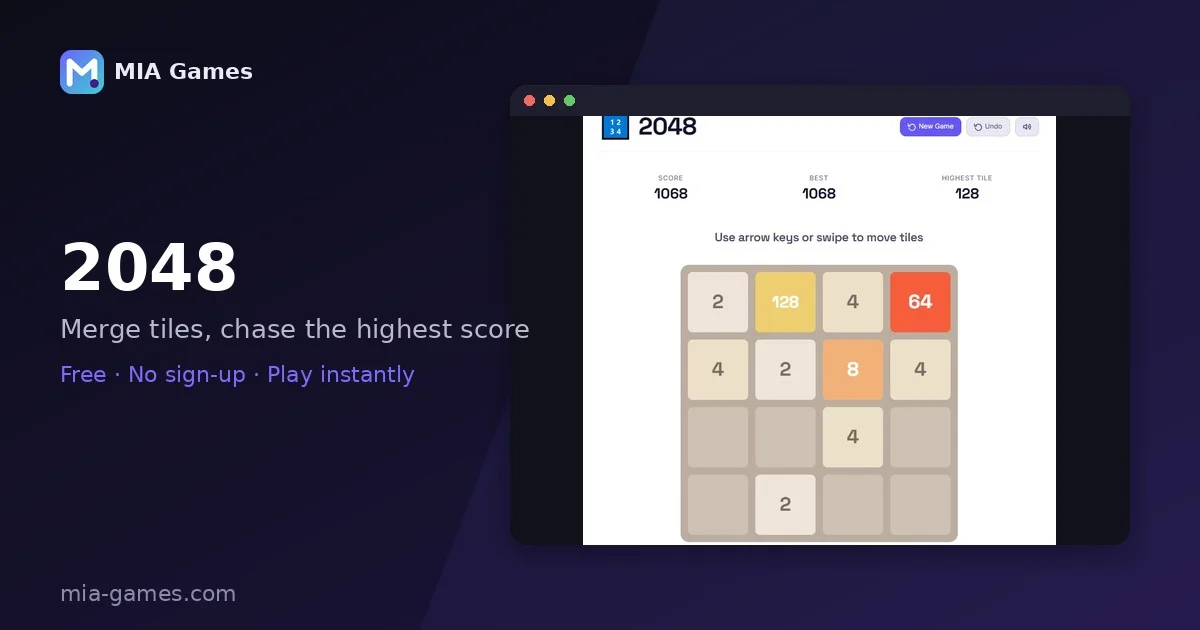
Our MIA Games 2048 is perfect for this. It loads instantly, there are no ads during gameplay, and the undo button means you can experiment without fear. Plus, your high score is saved locally so you can track your progress over time.
The Pomodoro Technique Connection
This approach fits perfectly with the Pomodoro Technique — the productivity method where you work for 25 minutes, then take a 5-minute break. Instead of spending that 5-minute break on social media, use it to play a game of 2048.
Many of our players at MIA Games use this exact approach. They work for 25 minutes, play a quick round of 2048, and return to work feeling refreshed. It's a sustainable rhythm that prevents burnout and maintains high productivity throughout the day.
⏰ Pro Tip: Combine 2048 with the Pomodoro Technique. Work for 25 minutes, then play 5 minutes of 2048. This rhythm prevents burnout and maintains high productivity.
Frequently Asked Questions
Can a game really reset my focus?
Yes. A strategic mental break — one that engages different cognitive skills than your work — can replenish depleted executive functions. This is supported by cognitive science research on focused vs. diffuse mode thinking.
How long should I play 2048 for a focus reset?
Most experts recommend 5-10 minutes for a cognitive reset. Any longer and you risk losing your work rhythm; any shorter and you may not get the full benefit.
Is 2048 better than social media for a break?
Yes. Social media fragments your attention and increases cognitive load. 2048 provides a structured, engaging activity that allows your brain to rest while staying active in a different way.
Can I use other games for the same purpose?
Absolutely. Minesweeper, Sudoku, and Memory Match can also work well. The key is to choose a game that's different from your work and engages different cognitive skills.
What is the Pomodoro Technique?
The Pomodoro Technique is a time management method where you work for 25 minutes, then take a 5-minute break. It's designed to improve focus and prevent burnout. Playing 2048 during the break is a great way to maximise its benefits.
Does 2048 have any cognitive benefits beyond focus resets?
Yes. 2048 improves strategic thinking, pattern recognition, and forward planning. Regular play can enhance these cognitive skills over time, making it a form of brain training as well as a focus tool.
Other Games for Mental Breaks
While 2048 is my personal favourite for cognitive resets, other games can also work well:
- Minesweeper — For a more logic-based mental shift.
- Sudoku — For a pattern-based cognitive reset.
- Memory Match — For a memory-focused break.
- Simon — For a quick pattern recall challenge.
The key is to choose a game that's different from your work. If you do analytical work, choose a spatial or pattern-based game. If you do creative work, choose a logic-based game. The contrast is what creates the cognitive reset.
Try It Yourself
The next time you feel your focus slipping, try this experiment:
- Set a timer for 5 minutes.
- Play 2048 until the timer goes off.
- Return to your work.
- Notice the difference.
This technique has transformed the way our team works. It's not about avoiding work — it's about working smarter. By giving your brain the breaks it needs, you can maintain high levels of focus and productivity throughout the day.
And the best part? It's free, it's fun, and it's available right now. Play 2048 on MIA Games and experience the focus reset for yourself.
Happy merging, and happy working!