📌 Key Takeaways
- Sudoku is a logic puzzle — no maths skills required, just careful reasoning
- Start with Easy puzzles and learn the basics before moving to harder levels
- Use pencil marks (notes) to track possible candidates for each cell
- Look for Naked Singles and Hidden Singles first — they're the easiest to spot
- Patience and systematic scanning are more important than speed
Sudoku is one of the world's most popular logic puzzles — and for good reason. It's simple to learn, endlessly challenging, and incredibly satisfying to solve. Whether you're new to puzzles or looking to sharpen your skills, this guide will teach you everything you need to know to start solving Sudoku like a pro.
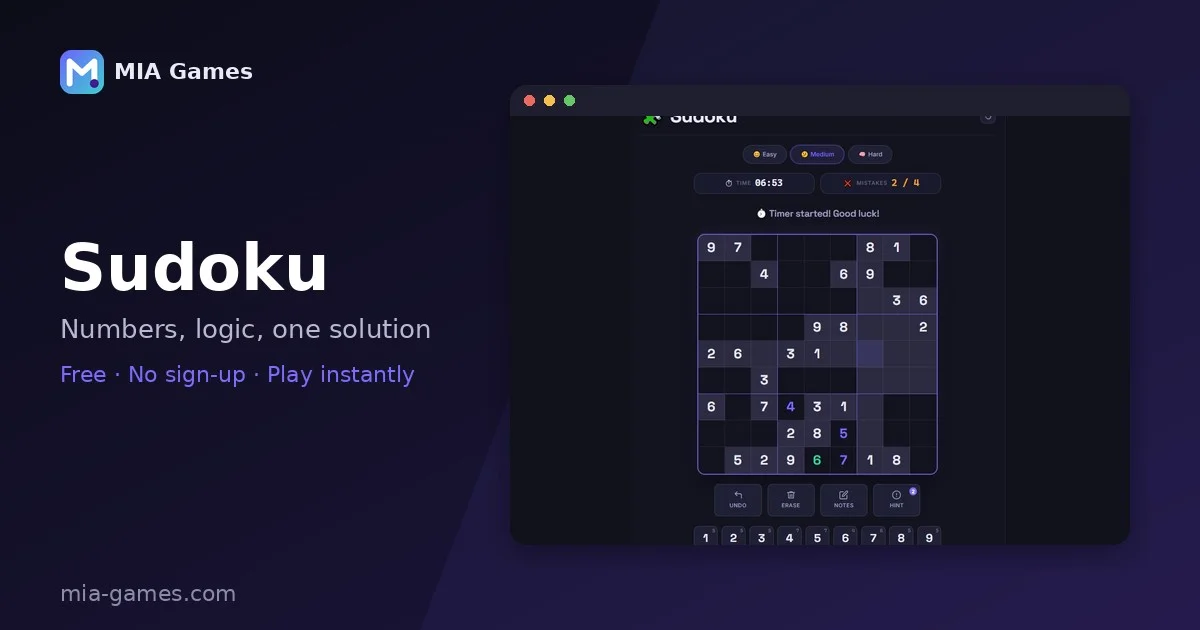
At MIA Games, we offer a free online Sudoku game with three difficulty levels: Easy, Medium, and Hard. But before you jump in, let's cover the basics.
What Is Sudoku?
Sudoku is a number-placement puzzle played on a 9×9 grid. The grid is divided into nine 3×3 boxes. Some cells are pre-filled with numbers — these are your starting clues. Your goal is to fill every empty cell with a digit from 1 to 9, following three simple rules:
- Every row must contain each digit 1 through 9 exactly once
- Every column must contain each digit 1 through 9 exactly once
- Every 3×3 box must contain each digit 1 through 9 exactly once
🔑 Key Insight: Sudoku is a logic puzzle, not a maths puzzle. You don't need to be good at maths — you just need to be good at thinking logically.
A Brief History of Sudoku
Sudoku as we know it today has an interesting history. The puzzle's modern form was first published in 1979 by Howard Garns, an American architect, under the name "Number Place" in Dell Magazines. It wasn't until 1986 that the puzzle gained widespread popularity in Japan, where it was published by Nikoli, a puzzle company that gave it the name "Sudoku" — meaning "the numbers must occur only once."
The game's international explosion came in 2004 when The Times newspaper in London began publishing Sudoku puzzles. Within months, Sudoku had become a global phenomenon, appearing in newspapers, books, and websites around the world. Today, Sudoku is one of the most widely recognised and played logic puzzles in existence — and it's easy to see why.
Getting Started: Basic Rules
When you open a Sudoku puzzle, you'll see a 9×9 grid with some numbers already filled in. These are your starting clues. The puzzle is designed so that there's only one correct solution — every cell has exactly one digit that fits.
To play, you fill in the empty cells using the three rules above. You can't repeat a digit in any row, column, or 3×3 box. It sounds simple, but the challenge comes from figuring out which digit goes where.
Understanding the Grid
Let's break down the Sudoku grid into its three components:
- Rows: There are 9 rows, numbered 1 (top) to 9 (bottom). Each row must contain all digits 1-9 exactly once.
- Columns: There are 9 columns, numbered 1 (left) to 9 (right). Each column must contain all digits 1-9 exactly once.
- Boxes: There are 9 boxes (3×3 squares). Each box must contain all digits 1-9 exactly once.
The interplay between these three constraints is what makes Sudoku challenging. Every number you place is constrained not just by its row and column, but also by its 3×3 box. This overlapping constraint system is what creates the puzzle's complexity.
The Basic Strategy: Naked Singles
The simplest strategy in Sudoku is the Naked Single. This is when a cell can only contain one possible digit because all other digits are already present in the same row, column, or box.
For example, if a row already has digits 1, 2, 3, 4, 5, 6, 7, and 8, the only missing digit is 9. So the remaining cell in that row must be 9. This is the most straightforward way to solve puzzles — and it's where every beginner should start.
In our MIA Games Sudoku, you can spot these easily because the interface highlights the row, column, and box of the cell you've selected. This visual aid is especially helpful when you're first learning.
Advanced Strategy: Hidden Singles
A Hidden Single is when a digit can only go in one cell within a row, column, or box — even if that cell appears to have multiple candidates.
For example, in a box, if the number 5 can only go in one cell (because all other cells in that box already have 5 in their row or column), that's a hidden single. This strategy requires a bit more thought but is very effective. It's often the key to unlocking puzzles that seem stuck.
Intermediate Techniques
Once you've mastered Naked and Hidden Singles, you can move on to more advanced techniques. Here are two essential ones:
Naked Pairs
A Naked Pair occurs when two cells in the same row, column, or box contain the same two candidates (and no others). This means those two digits must be placed in those two cells — and they can be eliminated from all other cells in that row, column, or box.
Pointing Pairs
A Pointing Pair occurs when a digit appears as a candidate in only two cells within a box, and those two cells are in the same row or column. This means that digit must be placed somewhere in that row or column within the box — so it can be eliminated from the rest of that row or column outside the box.
These techniques are essential for Medium and Hard puzzles. They require a bit more practice, but they'll dramatically improve your solving speed and accuracy.
Common Sudoku Terms You Should Know
- Candidate: A digit that could potentially go in a cell.
- Given: A pre-filled digit at the start of the puzzle.
- Naked Pair: Two cells in a unit that contain the same two candidates.
- Hidden Single: A digit that can only go in one cell within a unit.
- Box: A 3×3 square within the grid.
- Unit: A row, column, or box.
Beginner-Friendly Techniques
Scanning
Systematically check each row, column, and box for missing digits. This is the most important skill to develop.
Pencil Marks
Write down all possible candidates for each empty cell. This helps you spot patterns and eliminate possibilities.
Cross-Hatching
Look at a digit and see where it can go in a row, column, or box. Eliminate cells where it's already present.
Naked Pairs
If two cells in a unit have the same two candidates, those candidates can be eliminated from all other cells in that unit.
Difficulty Levels Explained
At MIA Games Sudoku, we offer three difficulty levels. Here's what each one means:
- 😊 Easy (36 clues): Puzzles are solvable with naked and hidden singles. No advanced techniques are needed. Perfect for beginners.
- 🤔 Medium (28 clues): Requires naked pairs, pointing pairs, and box-line reduction. A satisfying challenge for regular players.
- 🧠 Hard (24 clues): Demands X-Wings, Swordfish, and other advanced elimination techniques. Designed for experienced solvers.
💡 Pro Tip: Start with Easy puzzles and work your way up. Each difficulty introduces new techniques, so it's best to master one level before moving to the next.
Common Mistakes Beginners Make
- Guessing: Sudoku is a logic puzzle. If you're guessing, you're missing a logical step. Go back and look again — there's always a deduction to be made.
- Ignoring Candidates: Pencil marks are your best friend. Write them down — they'll reveal patterns you might otherwise miss. Our MIA Games Sudoku has a Notes mode specifically for this.
- Stopping Too Soon: If you get stuck, try a different approach. Sometimes looking at the puzzle from a different angle reveals the solution. Try focusing on a different digit or a different box.
- Rushing: Sudoku rewards patience. Take your time and double-check your work. A single mistake can cascade into a completely unsolvable puzzle.
Pro Tips for Success
- Start with the most constrained cell: A cell with only two candidates is easier to solve than one with five. This gives you an entry point.
- Use the Notes feature: On MIA Games Sudoku, you can use the Notes mode to pencil in candidates without committing to them. This is essential for Medium and Hard puzzles.
- Verify your work: After placing a digit, quickly check that it doesn't break any of the three rules. A moment of verification saves hours of frustration.
- Don't be afraid to erase: If you make a mistake, erase it and try again. Learning from errors is part of the process — even experienced solvers make mistakes.
Frequently Asked Questions
Is Sudoku a maths puzzle?
No. Sudoku is a logic puzzle that uses numbers, but it doesn't require any arithmetic or mathematical skills. The numbers 1-9 could be replaced with any symbols — they just need to be unique within each row, column, and box.
How do I get better at Sudoku?
Practice is the most important factor. Start with Easy puzzles, use pencil marks, and focus on systematic scanning. As you become more comfortable, gradually move to harder difficulties. Each puzzle teaches you something new.
What is the best strategy for Sudoku?
The best strategy is systematic scanning. Check each row, column, and box for missing digits. Use pencil marks to track candidates. Start with Naked Singles, then Hidden Singles, and gradually incorporate more advanced techniques as needed.
Can Sudoku improve my brain health?
Research suggests that regular engagement with cognitively stimulating activities — including logic puzzles like Sudoku — supports cognitive health. The ACTIVE study found that structured cognitive training produced measurable improvements in reasoning and processing speed.
What's the difference between Easy, Medium, and Hard Sudoku?
The difference is the number of starting clues and the complexity of the logic required. Easy puzzles have more clues (around 36) and can be solved with simple techniques. Hard puzzles have fewer clues (around 22) and require advanced techniques like X-Wings and Swordfish.
Can I play Sudoku online for free?
Yes! MIA Games offers a free online Sudoku game with three difficulty levels, a Notes system, and no downloads required. It works on any device with a browser.
Ready to Play?
Now that you understand the basics, it's time to put your skills to the test. Play Sudoku on MIA Games and start solving puzzles today. With three difficulty levels and a built-in notes system, you'll be a Sudoku master in no time.
Good luck, and happy solving!