📌 Key Takeaways
- Snake is a game of planning, not reaction — think ahead
- Never trap yourself in a corner — always have an escape route
- Use the "Snake" (zig-zag) pattern to systematically eat food
- Predict where food will appear and position yourself accordingly
- Consistency and patience matter more than speed
Snake — the game that defined mobile gaming before smartphones even existed. Many of us remember the first time we played it on a Nokia 6110 in the late 1990s. The concept was deceptively simple: guide a growing snake around a grid, eating food while avoiding your own tail and the walls. But beneath that simplicity lies a game of spatial awareness, predictive planning, and split-second decision-making.
At MIA Games, we've brought this timeless classic to the browser with our Snake game. Over the years, our team has studied the patterns of high-scoring players — the ones who can fill the entire grid without crashing. In this guide, we'll share the secrets they use to achieve those incredible scores. Whether you're a beginner or a seasoned player, these strategies will take your game to the next level.
💡 Key Insight: Snake is a game of planning, not reaction. The best players don't react to where the food is — they guide the food to where they want it to be by controlling the snake's position.
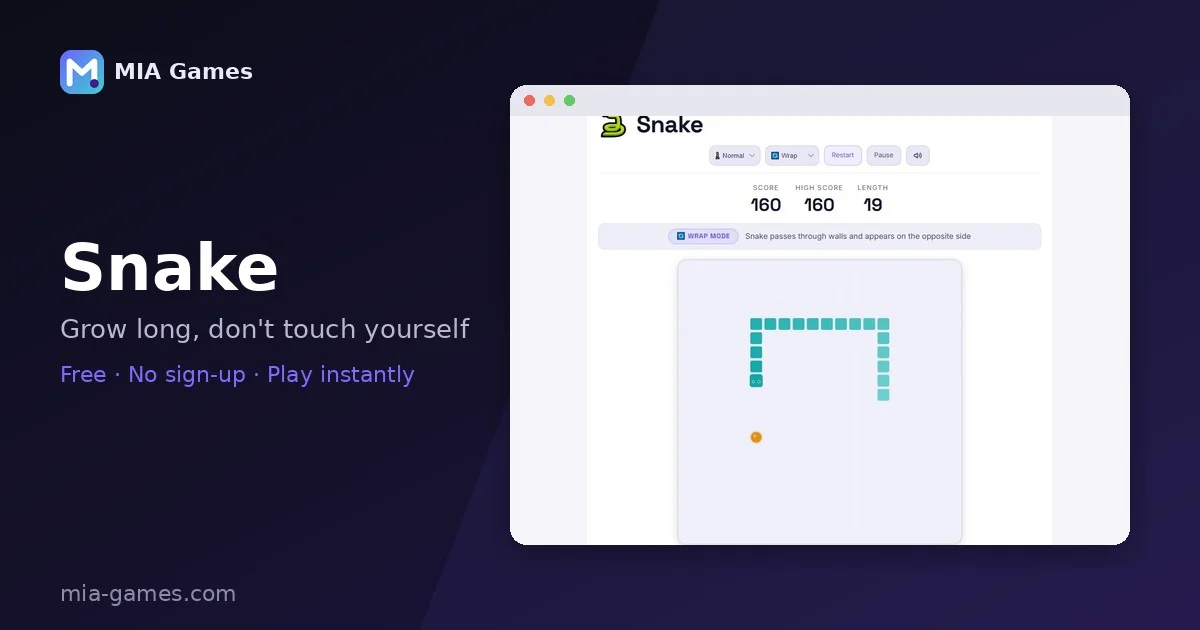
A Brief History of Snake
The Snake game has a surprisingly long history. The earliest known version was "Blockade", created in 1976 by Gremlin Industries. It was a two-player arcade game where players controlled snakes that left trails, and the goal was to survive longer than your opponent without crashing.
The game that most people recognise, however, was created in 1997 by Taneli Armanto, a Finnish software engineer working for Nokia. He designed a version of the game for the Nokia 6110 — one of the first phones to feature a graphical LCD display. Armanto's version was simple, addictive, and pre-installed on millions of phones. It became a global phenomenon, introducing mobile gaming to a generation of players who had never played a video game before.
Today, Snake lives on in countless browser versions — including ours at MIA Games — proving that great game design is timeless.
Understanding the Basics
Before we dive into advanced strategies, let's make sure we're on the same page. Snake is played on a grid where you control a snake that moves continuously. Your goal is to eat food (the red square) to grow longer while avoiding:
- Walls: In our MIA Games version, hitting the wall is game over. You need to stay within the grid boundaries.
- Your own tail: The snake can't touch itself at any point. As the snake grows, this becomes increasingly challenging.
- Running out of moves: On higher difficulty levels, speed increases over time, making it harder to react quickly.
The score increases by 1 for each piece of food eaten. The longer you survive, the higher your score — but the snake also gets longer, making it harder to navigate. This is the core challenge of Snake: balancing growth with survival.
The Golden Rule: Never Corner Yourself
This is the single most important rule in Snake: never trap yourself in a corner. A corner is a dead end — if you enter one, you have only one way out (back the way you came). If your snake is long enough, turning around inside a corner is often impossible.
The key to avoiding corners is to always have an escape route. Before you move into any area, ask yourself: "If the food appears in an inconvenient place, can we get out of here?" If the answer is no, don't enter that area.
🎯 Pro Tip: Beginners often chase food directly. Instead, guide the snake toward the food while keeping your path open. The shortest path isn't always the safest path.
Strategy 1: The "Snake" Pattern (Grid Navigation)
The most effective high-score strategy is the "Snake" pattern — also known as the "zig-zag" or "serpentine" method. This involves moving the snake in a predictable back-and-forth pattern across the grid, systematically eating food as you go.
Here's how it works on a 20×20 grid (like our MIA Games version):
- Step 1: Move to the top-left corner.
- Step 2: Move right across the top row.
- Step 3: Move down one row.
- Step 4: Move left across the second row.
- Step 5: Move down one row.
- Step 6: Move right across the third row.
- Continue this pattern until you've filled the entire grid.
This pattern ensures you're always moving efficiently and never get trapped. The snake fills the grid row by row, and the food will naturally be eaten as you pass through each cell.
Strategy 2: The "Spiral" Pattern
An alternative to the snake pattern is the "spiral" pattern. Start from the outside and work your way inward in a spiral. This can be more efficient on larger grids because it keeps the snake's body concentrated in one area, leaving the rest of the grid open for movement.
- Step 1: Move along the top edge from left to right.
- Step 2: Move down the right edge.
- Step 3: Move left along the bottom edge.
- Step 4: Move up the left edge (but one row inside).
- Continue spiraling inward until the grid is full.
The spiral pattern is particularly useful when the snake is long, as it keeps the body tight and reduces the risk of accidentally hitting your tail.
Strategy 3: Predictive Movement
High-scoring players don't just move toward the food — they predict where the food will appear next. Food spawns randomly, but you can influence your odds by positioning the snake in the area with the most open space.
- Stay near the center: The center of the grid has the most open space and the most options for movement.
- Don't chase: If food appears far away, don't rush toward it. Instead, move methodically toward it while keeping your path open.
- Use the "wait and see" approach: Sometimes it's better to wait (or make small, safe moves) until the food appears in a better location.
Strategy 4: Wall Management
In our MIA Games Snake, hitting the wall means game over. But you can use the walls to your advantage:
- Use walls as guides: The walls can help you maintain the snake pattern. They're like "guard rails" that keep you on track.
- Stay one cell away: Never move directly along the wall if you can avoid it. Staying one cell away gives you room to turn.
- Corner turns: When turning in a corner, make sure you have enough space to complete the turn without hitting yourself.
Advanced Techniques
1. The "Tail Follow" Technique
When your snake is very long, you can use your tail as a guide. Follow the path your tail is leaving — this ensures you're always moving into safe territory because the tail is constantly freeing up space behind it.
2. The "Two-Cell Buffer"
Always leave at least two cells of space between your head and any obstacle (wall or tail). This gives you room to make a quick turn if the food appears in an unexpected location.
3. The "Pattern Interruption" Technique
Sometimes, breaking your pattern intentionally can create better opportunities. If food keeps spawning in areas you're not covering, a strategic interruption can guide the food toward your path.
Key Strategies Summary
Snake Pattern
Navigate the grid in a back-and-forth pattern to systematically eat food.
Spiral Pattern
Work your way from the outside inward to keep the snake's body tight.
Predictive Movement
Anticipate where food will spawn and position yourself accordingly.
Wall Management
Use walls as guides and avoid cornering yourself.
Escape Routes
Always have at least two ways out of any position.
Pace Yourself
Speed increases over time — plan your moves ahead.
Common Mistakes to Avoid
- Rushing: Speed is important, but accuracy is more important. One wrong move costs you the game. Slow down and think before you move.
- Chasing food directly: Going straight toward food often traps you. Take the scenic route — it's safer.
- Ignoring your tail: Always know where your tail is — especially when you're about to turn. Hitting your tail is one of the most common ways to lose.
- Panicking under pressure: The game speeds up. Stay calm and keep planning. Panic leads to mistakes.
- Sticking to one pattern too rigidly: While patterns are helpful, being too predictable can limit your options. Learn to adapt.
How to Practice and Improve
Here's a training plan to build your Snake skills:
- Week 1: Play on the slowest speed. Focus on never crashing. Score is secondary. Aim to survive for 30 seconds without hitting anything.
- Week 2: Practice the snake pattern on the slowest speed. Can you fill half the grid without crashing?
- Week 3: Increase speed slightly. Focus on maintaining the pattern at higher speeds. Practice the spiral pattern as an alternative.
- Week 4: Alternate between patterns and work on predictive movement. Can you anticipate where food will appear?
- Week 5: Try to beat your high score. Focus on consistency over flashy moves. The goal is to survive longer, not to eat every piece of food quickly.
Frequently Asked Questions
What's the best strategy for Snake?
The "Snake" (zig-zag) pattern is widely considered the most effective strategy. It allows you to systematically cover the grid while maintaining safe movement. Combine this with predictive movement and you'll see significant improvement.
Is Snake a game of luck or skill?
Mostly skill. While food spawns randomly, skilled players can position themselves to minimise the impact of randomness. The best players can consistently achieve high scores regardless of where food appears.
How do you avoid hitting your own tail?
Always be aware of where your tail is. When you're about to turn, visualise the path your tail is taking. Following your tail's path is a safe way to move when the snake is long.
What's the highest possible score in Snake?
In theory, the highest possible score is achieved by filling the entire grid with your snake's body. On a 20×20 grid, that's 400 cells — so the maximum score is 399 (since you start with a length of 1). In practice, most players never reach this, but it's the ultimate goal.
Can I play Snake on my phone?
Yes. MIA Games Snake is fully responsive and works on any device with a browser. You can use swipe controls on touchscreens or keyboard controls on desktop.
Why does the snake speed up over time?
The speed increase is designed to add challenge. As you get better at the game, the increased speed tests your reflexes and decision-making. It's a classic game design technique to maintain engagement.
Ready to Play?
Now that you have these strategies, it's time to put them into practice. Play Snake on MIA Games and start applying these techniques. Remember: the key to a high score isn't speed — it's planning, patience, and practice.
And if you're looking for more brain-training fun, check out our other classic games like 2048, Minesweeper, and Sudoku. Each one offers unique challenges that will keep your mind sharp.
Good luck, and keep slithering!