📌 Key Takeaways
- Sudoku trains logical reasoning and working memory
- 2048 develops strategic planning and adaptive thinking
- Both games engage different brain regions
- Neither is "better" — they serve different purposes
- The ideal brain workout includes both games
It's a question our team gets asked all the time. "Which game is better for my brain — Sudoku or 2048?" And honestly, it's a great question. Both games are wildly popular, both are considered "brain training," and both have passionate fans who swear by their chosen puzzle.
At MIA Games, we offer both Sudoku and 2048, so we've had the chance to observe how players engage with each game. We've also dug into the research to understand what each game actually does for your brain. And the answer to the question isn't as simple as you might think.
The truth is, both games are excellent for your brain — but they train different cognitive skills. The "better" game depends entirely on what you want to improve. Let's break it down.
💡 The Bottom Line: Sudoku is better for logical reasoning and working memory. 2048 is better for strategic planning and forward-thinking. The ideal brain workout includes both.
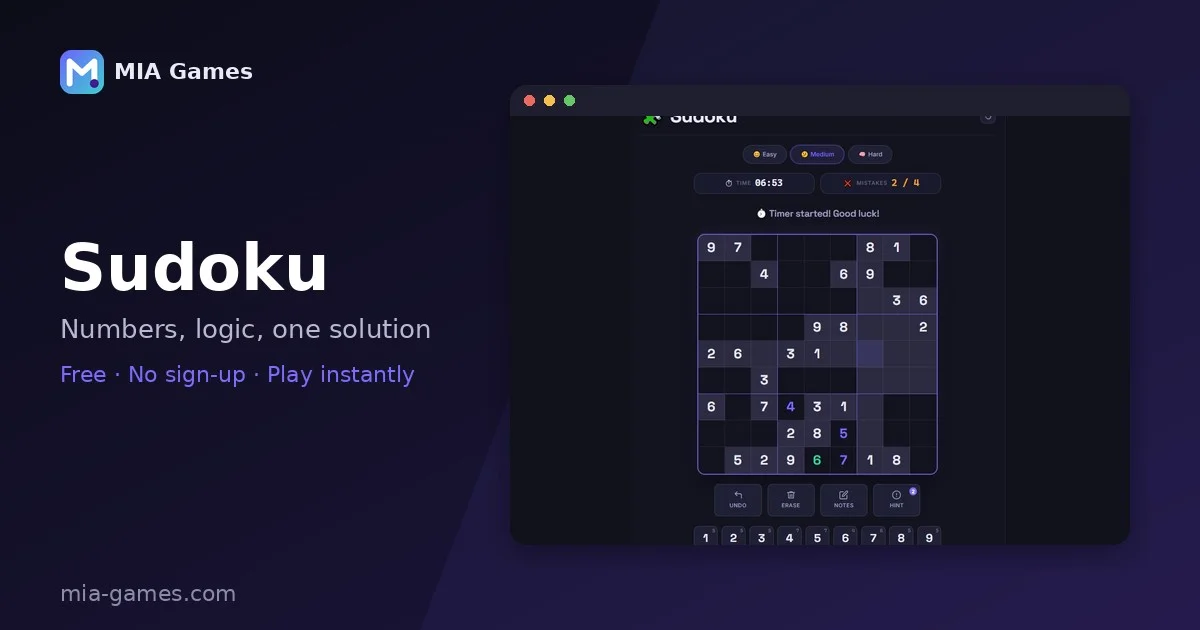
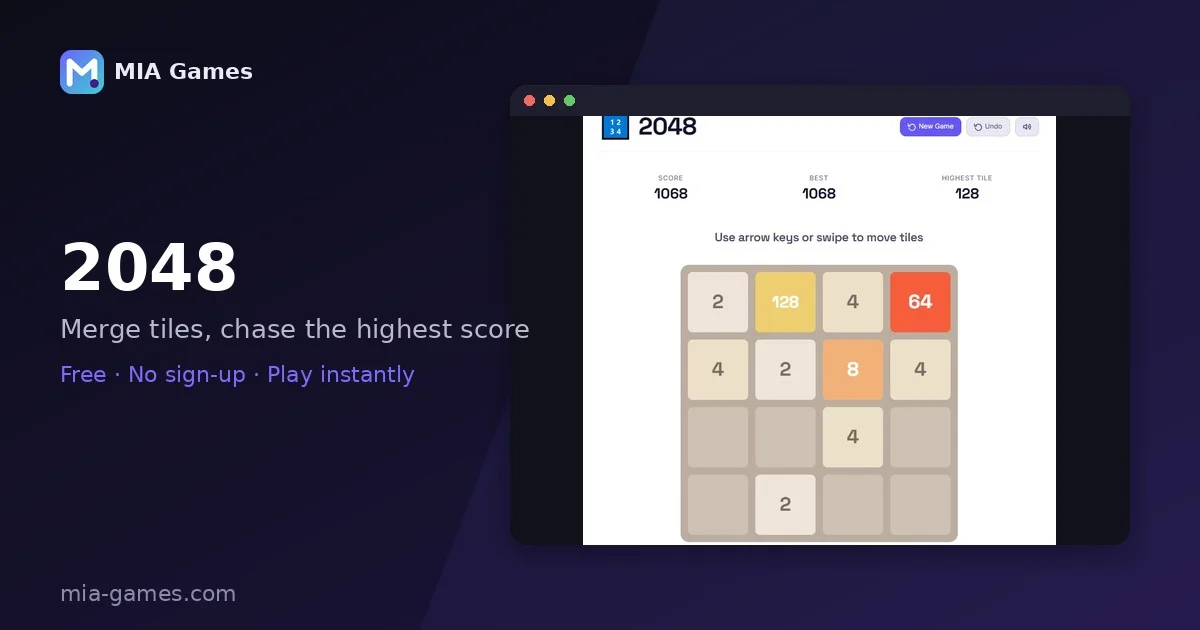
Sudoku: The Logic Master
Sudoku is a number-placement puzzle that requires pure logical deduction. There's no luck involved — just you, the numbers, and the rules. You need to fill a 9×9 grid so that every row, column, and 3×3 box contains the digits 1–9 exactly once.
What makes Sudoku so powerful for brain training is its constraint-based reasoning. Every number you place is constrained by the numbers already in its row, column, and box. You have to track multiple constraints simultaneously and make deductions based on incomplete information.
What Sudoku Trains
- Logical reasoning: The ability to make deductions from limited information.
- Working memory: Holding multiple constraints in your mind while solving.
- Pattern recognition: Identifying common patterns like naked singles and hidden pairs.
- Systematic thinking: Approaching problems methodically and eliminating possibilities.
- Patience and persistence: Sticking with a problem until it's solved.
📊 What We Know: Number-placement puzzles like Sudoku require holding several candidate numbers in mind at once while testing and discarding possibilities — a workout for working memory and logical deduction. Puzzle-based cognitive training is a well-studied area, and games that demand sustained, structured reasoning (like Sudoku) are consistently among the types researchers point to when discussing "brain training" benefits — though results vary by individual and how regularly the puzzles are played.
Best For
- Analytical thinkers who enjoy logic puzzles.
- People who prefer solo, contemplative activities.
- Anyone looking to improve working memory and reasoning.
- Older adults concerned about cognitive decline.
2048: The Strategic Planner
2048 is a sliding-tile puzzle where you merge matching numbers to reach the elusive 2048 tile. It's a game of forward planning and strategic thinking. Every move has consequences, and you need to think several moves ahead to succeed.
What makes 2048 different from Sudoku is its dynamic nature. The board changes with every move, and new tiles appear randomly. You can't just follow a fixed strategy — you need to adapt continuously to changing conditions.
What 2048 Trains
- Strategic planning: Thinking several moves ahead and anticipating outcomes.
- Adaptive thinking: Adjusting your strategy based on changing conditions.
- Risk assessment: Evaluating the trade-offs between different moves.
- Forward thinking: Anticipating how the board will change.
- Decision-making under uncertainty: Making choices when outcomes aren't guaranteed.
📊 What We Know: 2048 forces you to plan several moves ahead while conditions keep shifting — every merge changes the board state, so you're constantly re-evaluating your strategy. This kind of "adapt-as-you-go" decision-making is the same mental muscle used in real-world planning under uncertainty, even without a specific study attached to the number 2048 itself.
Best For
- Strategic thinkers who enjoy planning ahead.
- People who thrive on dynamic, changing challenges.
- Anyone looking to improve decision-making and foresight.
- Those who enjoy a mix of luck and skill.
Side-by-Side Comparison
Sudoku
Pure logic and deduction. No luck involved. Every puzzle has exactly one solution.
2048
Strategic planning with randomness. New tiles appear randomly, forcing adaptation.
| Factor | Sudoku | 2048 |
|---|---|---|
| Primary Skill | Logical deduction | Strategic planning |
| Working Memory | ⭐ High demand | ⭐ Moderate demand |
| Forward Planning | ⭐ Limited (constraints are static) | ⭐ High demand (dynamic board) |
| Adaptability | ⭐ Low (fixed puzzle) | ⭐ High (random tile spawns) |
| Luck Factor | ⭐ None | ⭐ Moderate (tile spawns) |
| Difficulty Scaling | ⭐ 3 difficulty levels | ⭐ Increasing speed + larger board |
| Completion Time | ⭐ 5-30 minutes per puzzle | ⭐ 2-10 minutes per game |
| Cognitive Fatigue | ⭐ High (intense concentration) | ⭐ Moderate (dynamic engagement) |
The Science of Cognitive Training
Both games are effective cognitive training tools, but they target different brain regions:
- Sudoku primarily engages the prefrontal cortex — the part of the brain responsible for executive function, reasoning, and working memory.
- 2048 engages the prefrontal cortex as well, but also activates the parietal lobe (spatial reasoning) and basal ganglia (habit formation and decision-making).
Neuroscientists broadly associate structured logic tasks (like Sudoku) with the prefrontal cortex — the brain region responsible for planning, reasoning, and working memory — while tasks requiring adaptive, shifting strategy (like 2048) draw more on the brain's decision-making and pattern-adjustment circuitry. In simple terms: these two games flex your brain in genuinely different ways, which is exactly why alternating between them, rather than sticking to just one, tends to give you a more well-rounded mental workout.
In other words, these games work different parts of your brain. That's why the best brain training routine includes both.
Frequently Asked Questions
Which game is better for brain training — Sudoku or 2048?
Neither is universally "better." Sudoku is better for logical reasoning and working memory. 2048 is better for strategic planning and adaptive thinking. The best approach is to play both for a well-rounded cognitive workout.
Does Sudoku really improve your brain?
Yes. Sudoku challenges logical reasoning, working memory, and pattern recognition. Regular practice can strengthen these cognitive skills, though the extent of transfer to unrelated tasks depends on how you play and how often.
Is 2048 good for your brain?
Yes. 2048 trains strategic planning, forward thinking, and decision-making under uncertainty. The dynamic nature of the game also develops adaptability and risk assessment skills.
Can I play both games on MIA Games?
Yes! Both Sudoku and 2048 are available for free on MIA Games. You can switch between them in the same session for a complete brain workout.
How long should I play each game?
For cognitive benefits, 10-15 minutes per game is a good target. Playing both games in a session (10 minutes each) gives you a 20-minute brain workout that targets multiple cognitive skills.
Which game is better for older adults?
Both games are excellent for older adults, but they serve different purposes. Sudoku is great for maintaining logical reasoning and working memory. 2048 helps maintain strategic thinking and adaptability. Alternating between them is ideal.
Which One Should You Play?
Here's my recommendation based on your goals:
Choose Sudoku if you want to:
- Improve logical reasoning — perfect for analytical work, coding, and problem-solving.
- Strengthen working memory — great for remembering complex information.
- Develop patience and persistence — Sudoku rewards careful, methodical thinking.
- Enjoy a calm, contemplative activity — perfect for winding down.
Choose 2048 if you want to:
- Improve strategic planning — ideal for project management, chess, and complex decisions.
- Enhance adaptability — perfect for fast-changing environments.
- Develop decision-making under uncertainty — great for real-world problem-solving.
- Enjoy a quick, engaging challenge — perfect for short breaks.
Choose both if you want to:
- Maximise cognitive benefits — train multiple brain regions simultaneously.
- Avoid boredom — variety keeps your brain engaged.
- Develop a well-rounded mind — logic, strategy, adaptability, and memory.
🧠 The Ultimate Brain Workout: Alternate between Sudoku and 2048. Play Sudoku when you want deep concentration, and play 2048 when you want dynamic strategic thinking. Your brain will thank you.
How to Get the Most Out of Each Game
Sudoku Tips
- Start with Easy puzzles and work your way up. Don't rush to Hard.
- Use the notes feature in our MIA Games Sudoku to track candidates.
- Focus on the most constrained cells — the ones with the fewest options.
- Don't guess — Sudoku is pure logic. If you're guessing, you're missing a deduction.
- Time yourself to track progress. Speed improves with practice.
2048 Tips
- Keep your highest tile in a corner — this is the most important strategy.
- Build a descending chain — high numbers in a row with decreasing values.
- Use the undo button in our MIA Games 2048 to learn from mistakes.
- Plan 3-4 moves ahead — think about where each tile will end up.
- Stay patient — rushing leads to mistakes.
Other Brain-Training Games at MIA Games
While Sudoku and 2048 are two of the best brain-training games available, they're not the only ones at MIA Games. Here are a few more that can round out your cognitive workout:
- Memory Match — Trains short-term memory and concentration.
- Simon — Enhances pattern recognition and auditory memory.
- Minesweeper — Develops logical deduction and spatial reasoning.
- Connect Four — Builds strategic thinking and foresight.
As we've written in our brain training guide, the most effective cognitive training involves variety. Different games train different skills — and together, they provide a comprehensive mental workout.
The Verdict
So, which game is better for your brain — Sudoku or 2048?
The honest answer is: it depends on what you want to achieve. If you want to improve logical reasoning and working memory, Sudoku is the winner. If you want to improve strategic planning and decision-making under uncertainty, 2048 takes the crown.
But here's the secret: you don't have to choose. The best brain training routine includes both games — and many others. At MIA Games, we've made it easy. You can play Sudoku and 2048 in the same session, switching between the two as your mood and focus dictate.
So why not try both? Explore our full collection and start training your brain today.
Happy puzzling!