📌 Key Takeaways
- Snake originated in 1976 as an arcade game called "Blockade"
- The Nokia version (1997) by Taneli Armanto defined mobile gaming
- Snake was played by over 350 million people worldwide
- It pioneered the concept of casual mobile gaming
- The game's simplicity and accessibility are why it endures
Our team remembers the moment vividly. It was 1997. Many of us remember a moment just like this one. It is 1997. You are sitting in the back of a car when someone hands you a brand new, when my older cousin handed me his brand new Nokia 6110. "Here," he said, "try this." I stared at the small monochrome screen, confused. Then the snake appeared — a blocky, pixelated creature that moved with a mind of its own. I pressed the 4 key, and it turned left. I pressed 6, and it turned right. Within seconds, I was hooked.
That was my first encounter with Snake, and I suspect it was the same for millions of people around the world. But the story of Snake didn't begin with Nokia, and it certainly didn't end there. This is the untold story of a game that became a global phenomenon — from its humble origins in the 1970s to its current status as a browser legend at MIA Games.
📱 By the Numbers: Snake is estimated to have been played by over 350 million people worldwide. At its peak, it was installed on more than 100 million Nokia phones annually. It remains one of the most-played games in human history.
1970s: The Arcade Origins
The earliest ancestor of Snake appeared in 1976, not on a mobile phone, but in the arcade. A game called "Blockade" was released by Gremlin Industries, and it featured two players controlling snakes that left trails behind them. The goal was simple: survive longer than your opponent without crashing into a wall or your own trail.
Blockade was a modest success, but it sparked a wave of imitators. Over the next few years, dozens of "snake" and "worm" games appeared in arcades and on early home computers. Games like Surround (1977) on the Atari 2600 and Worm (1979) on various platforms kept the concept alive. But Snake as we know it today was still years away.
What made Blockade different from later versions was its two-player focus. The competitive element — trying to outlast your opponent — was central to the experience. This social aspect would later be lost in the single-player mobile version, but it's interesting to note that Snake's roots were in shared, competitive play.
1990s: The Nokia Revolution
The game that truly defined Snake was created in 1997 by a Finnish software engineer named Taneli Armanto. Working for Nokia, Armanto designed a version of the game that would run on the company's newly launched Nokia 6110 — one of the first phones to feature a graphical LCD display.
Armanto's version was a masterclass in minimalist design. The snake moved on a simple grid, eating food and growing longer with each meal. The controls were intuitive: the 4, 6, 2, and 8 keys — or, for the more adventurous, the 1, 3, 7, and 9 keys for diagonal movement. The game was pre-installed on every phone, and it was free. That was the key to its success.
"We wanted something that anyone could pick up and play in seconds," Armanto said in a rare interview. "Snake was simple enough to understand immediately, but challenging enough to keep you coming back. And because it was on your phone, you could play it anywhere — in the car, on the bus, during boring meetings."
Armanto's version was also a technical achievement. It ran on a phone with limited memory and processing power, yet it was smooth and responsive. The game's code was remarkably efficient — a testament to the skill of Nokia's engineering team.
🤔 Did You Know? The original Nokia Snake had a high score of 9999 — but it was impossible to reach. The game's scoring system capped at 9999, but the maximum possible score on the 8-bit version was actually 9998. Nobody ever hit the cap legitimately.
Snake II and the Nokia 3310
In 2000, Nokia released the 3310 — a phone that became iconic for its durability and its Snake game. The version included on the 3310 was Snake II, an improved version with new features like:
- Walls as obstacles — in some versions, the snake could pass through walls; in others, walls were deadly.
- Speed increases over time, making the game progressively harder.
- Multiple difficulty levels to suit different skill levels.
The Nokia 3310 sold over 126 million units, making it one of the best-selling phones of all time. Snake II was pre-installed on almost every one of them, exposing the game to a global audience of unprecedented size.
The Global Phenomenon
Snake wasn't just a game — it was a cultural phenomenon. In the late 1990s and early 2000s, Snake was everywhere. It was the game you played during boring lectures, on long commutes, and during awkward family gatherings. It was the game that made Nokia phones cool.
The game's simplicity was its superpower. There were no complex controls to learn, no story to follow, no graphics to admire. Just you, a snake, and a dot of food. The challenge was purely mechanical: how long could you keep the snake alive? The answer, for most people, was "not long enough." And that's what made it addictive.
Snake also pioneered the concept of "mobile gaming" years before the iPhone and Android. It proved that people wanted to play games on their phones — and that they would play them in short bursts, during the gaps in their day. This was the beginning of the casual gaming revolution.
Key Moments in Snake History
Blockade
First snake-like game appears in arcades. Two-player, trail-based gameplay.
Nokia 6110
Taneli Armanto creates the definitive Snake version for Nokia phones.
Nokia 3310
Snake reaches its peak popularity on the iconic Nokia 3310. Over 126 million units sold.
iPhone Launch
Snake faces competition from touch-based games, but retains a loyal following.
HTML5 Era
Snake finds a new home in browsers. Countless versions are recreated in HTML5.
MIA Games
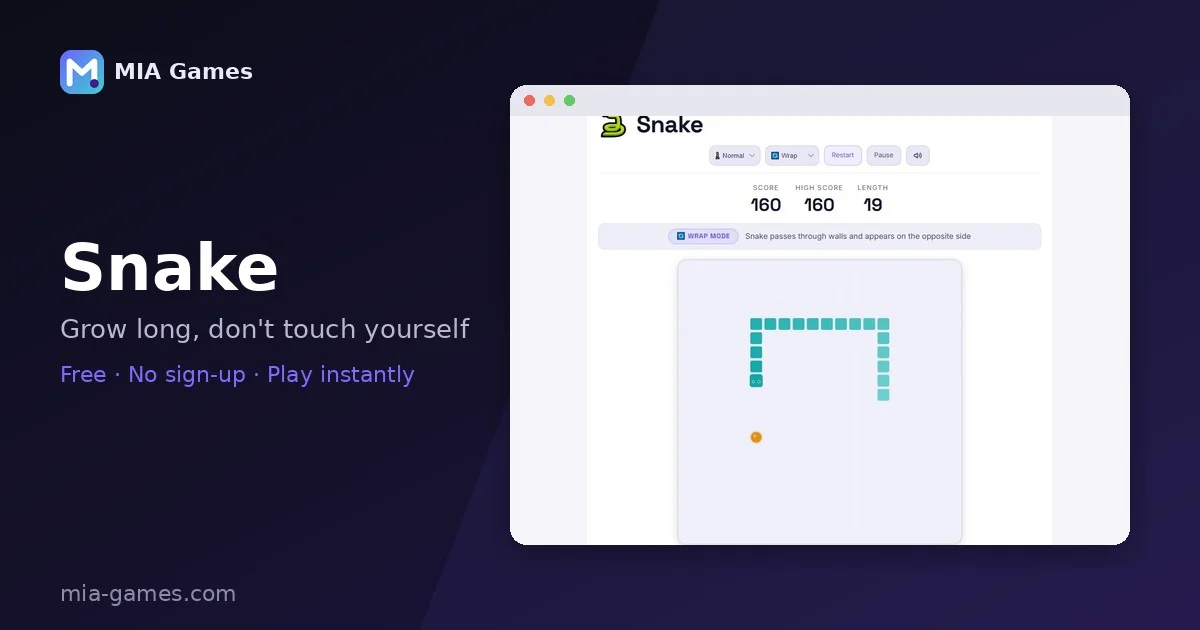
Our Snake brings the classic to modern browsers with high score tracking and responsive controls.
The Evolution of Snake
Over the years, Snake has evolved in countless ways. Let's look at some of the most significant iterations:
1. The Original Nokia Version (1997)
- Grid: 8×8 cells (on the 6110) and later 15×15 (on the 3310)
- Controls: Numeric keypad (4, 6, 2, 8 and diagonals 1, 3, 7, 9)
- Food: A single dot that appears randomly
- Scoring: 1 point per food eaten, max 9999
2. Snake II (2000)
- Introduced walls as obstacles (in some versions, the snake could pass through walls)
- Added speed increases over time
- Multiple difficulty levels
3. Browser Versions (2010–Present)
- Responsive design: Works on desktop, tablet, and mobile
- Touch controls: Swipe gestures for mobile players
- Keyboard controls: Arrow keys or WASD for desktop
- High score tracking: Saves your best score in localStorage
4. Modern Variations
- Colorful themes: Multiple color schemes (our MIA Games Snake offers several)
- Power-ups: Speed boosts, slow-motion, and extra lives in some versions
- Multiplayer: Competitive snake games (though not in the classic version)
- Endless mode: The game continues indefinitely with increasing difficulty
Snake's Cultural Impact
Snake's influence extends far beyond gaming. It shaped how we think about mobile devices and their capabilities. Before Snake, phones were tools for communication. After Snake, they became entertainment devices. This shift laid the groundwork for the smartphone revolution.
The game also influenced a generation of game designers. Many of today's indie developers cite Snake as their first gaming inspiration. Its minimalist design and perfect difficulty curve set a standard that game designers still aspire to.
As we wrote in our article on classic games, there's something deeply satisfying about games that don't overcomplicate themselves. Snake is the perfect example of this philosophy.
Why Snake Endures
Why does Snake still captivate players after nearly 30 years? We've thought about this a lot while building our Snake game at MIA Games. Here's what we've concluded:
- Simplicity: You can learn the rules in 10 seconds. No tutorials, no complicated mechanics.
- Instant gratification: Every move has immediate feedback. You eat, you grow. You crash, you lose.
- Compounding challenge: The game gets harder as you get better, because your snake gets longer.
- Nostalgia: For millions of people, Snake is a direct link to their childhood.
- Accessibility: It works on any device, anytime, anywhere.
Snake's Legacy
Snake didn't just popularise mobile gaming — it defined it. Before Angry Birds, before Candy Crush, before Pokémon Go, there was Snake. It proved that people wanted to play games on their phones, and that simple, casual games could be just as engaging as complex console titles.
At MIA Games, we're proud to carry on the Snake tradition. Our Snake game is a love letter to the original — faithful to the classic formula, but with modern enhancements that make it feel fresh. We've added:
- Multiple color themes (including the original monochrome look)
- High score tracking that saves your best score locally
- Responsive design that works on any screen size
- Keyboard and touch controls for seamless play on any device
We hope our version introduces Snake to a new generation of players — and reminds older players why they fell in love with it in the first place.
Frequently Asked Questions
Who created the Snake game?
The Nokia version of Snake was created in 1997 by Taneli Armanto, a Finnish software engineer working for Nokia. The original arcade concept, "Blockade," was created by Gremlin Industries in 1976.
What was the first Snake game?
The first snake-like game was "Blockade" (1976), an arcade game where two players controlled snakes that left trails. The concept was later adapted for mobile phones by Nokia.
Why was Snake so popular?
Snake was popular because it was simple, addictive, and pre-installed on Nokia phones. Millions of people discovered it without even trying — it was already there, ready to play.
Can I still play the original Snake game?
Yes. MIA Games Snake offers a modern version of the classic game with responsive controls, high score tracking, and multiple color themes. It works on any device with a browser.
What phone had Snake first?
The Nokia 6110 (1997) was the first phone to feature the original Snake game. It was followed by the Nokia 3310 (2000), which featured Snake II.
Is Snake still popular today?
Yes. Snake remains one of the most recognised and played games in history. It has been ported to countless platforms and continues to attract new players through browser versions like ours.
Ready to Play?
The story of Snake is still being written. Every time someone opens their browser and starts a new game, they're adding to the legacy. Play Snake on MIA Games and become part of gaming history.
And if you're curious about the history of other classic games, check out our complete history of browser games or explore our full blog for more gaming stories.
Keep slithering!